Clinical practice / Cases
Use Cases to practice a reasoning process
Approach an educational case by defining the problem, comparing explanations and identifying what evidence would change your mind.
Write a compact problem representation
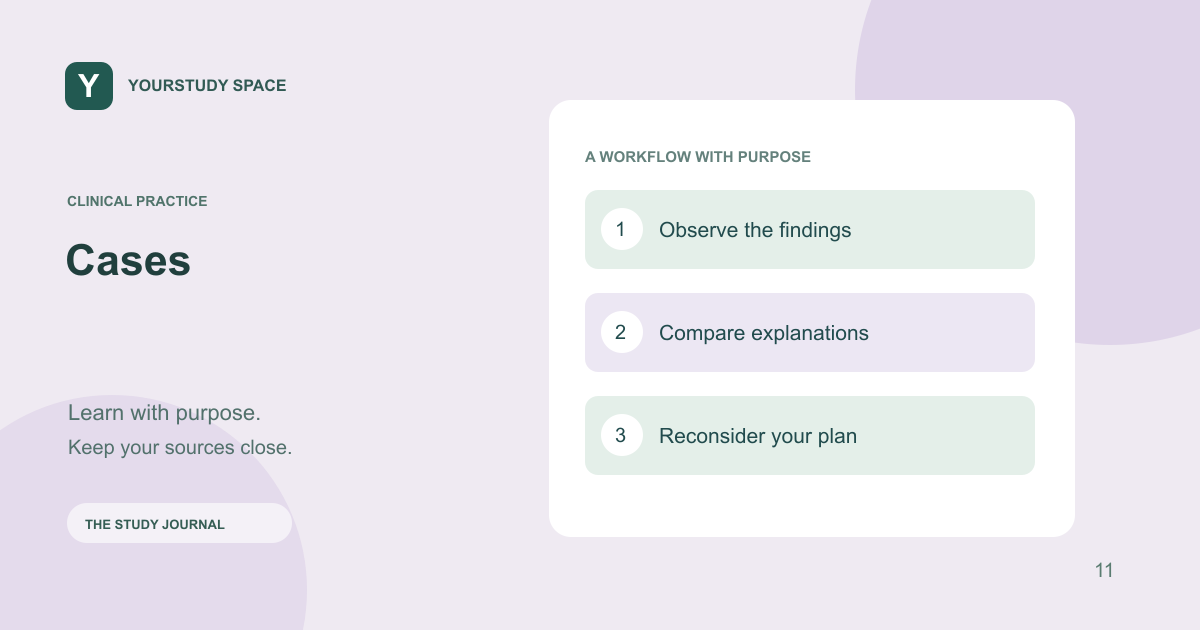
Begin with the few details that distinguish this presentation from many others: the person’s context, the timing, the main symptoms and the findings that matter most. In a fictional case, separate what is provided from what you are assuming. A missing detail is a question to ask, not permission to fill in the blank.
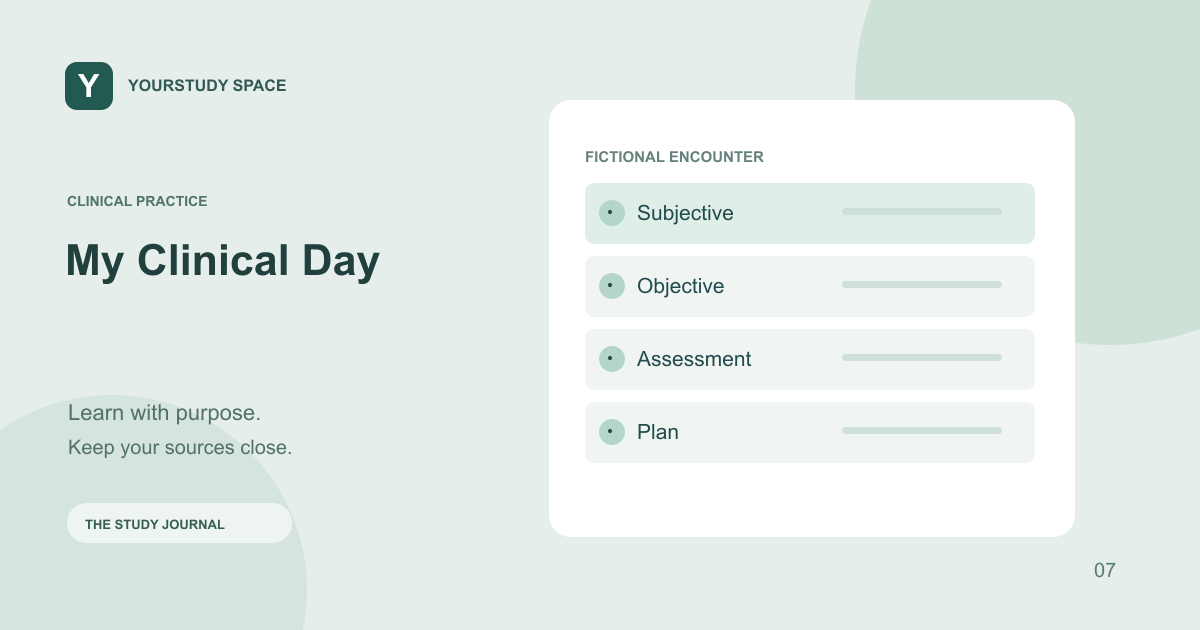
Cases in YourStudy Space supports educational reasoning around a presentation. Use it alongside My Clinical Day when you want to move between a focused discussion and an interactive chart-based encounter. They are related tools with different ways of working.
Compare explanations before choosing one
For each possible explanation, identify a supporting finding, a conflicting finding and a missing piece of information. You do not need a very long list to demonstrate reasoning. A short comparison with explicit uncertainty can be more useful to discuss with a teacher.
State your study role and setting. The same case can prompt different questions about diagnosis, monitoring, medication safety, communication or escalation. Your saved profile helps frame new content, but you should still say when a particular exercise has a different focus.
Ask what would change your next step
Before requesting another test in a simulation or case discussion, explain how its possible results would change the plan. This prevents the exercise from becoming a list of everything that could be ordered. It also exposes the difference between collecting information and using it.
When Tunza AI provides a rationale, inspect its references. A cited source must support the relevant claim, not merely mention the same condition. If guidance depends on severity, population or jurisdiction, include those qualifications in your summary.
Finish with a reasoning check
After the case, describe why your preferred explanation fits, what you still cannot exclude and what observation would make you reconsider. This is educational reflection, not a validated competence assessment. Take unresolved clinical questions to an instructor or supervisor rather than using the app to make real-patient decisions.
TRY THIS NEXT
For each proposed next step, explain what result would change your thinking.
Try it in the app ↗Sign-in and an active trial or membership are required for study tools.About this guide
This product guide was prepared with AI assistance and checked against the app’s implemented workflows. It is not independently clinically reviewed. Features and service availability can change. It contains no real patient information.
For study support only. Review generated content and its sources; do not use it for real-patient diagnosis or treatment. Read the study and AI disclaimer.
Found something that needs correcting? Contact the YourStudy Space team.