Clinical practice / Peer case conference
Run a peer case conference with a clear learning purpose
Structure a shared case discussion around observations, competing explanations, source checks and a closing reflection.
Choose a shared question
A peer case conference is most useful when the group knows what it is trying to resolve. Start with a fictional case and a question such as “Which finding would change our priorities?” or “What evidence supports this explanation?” Avoid posting real patient details or identifiable clinical records.
The conference owner can invite participants using the app’s sharing controls. Each participant should sign in with the intended account and check the access offered by that invitation. If the discussion is read-only, inspect the membership and conference status rather than sharing account credentials.
Separate observation from interpretation
Ask one person to summarize the available findings without adding a diagnosis. Then let others propose interpretations and identify what evidence would support or weaken them. This makes it easier to see where the disagreement begins.
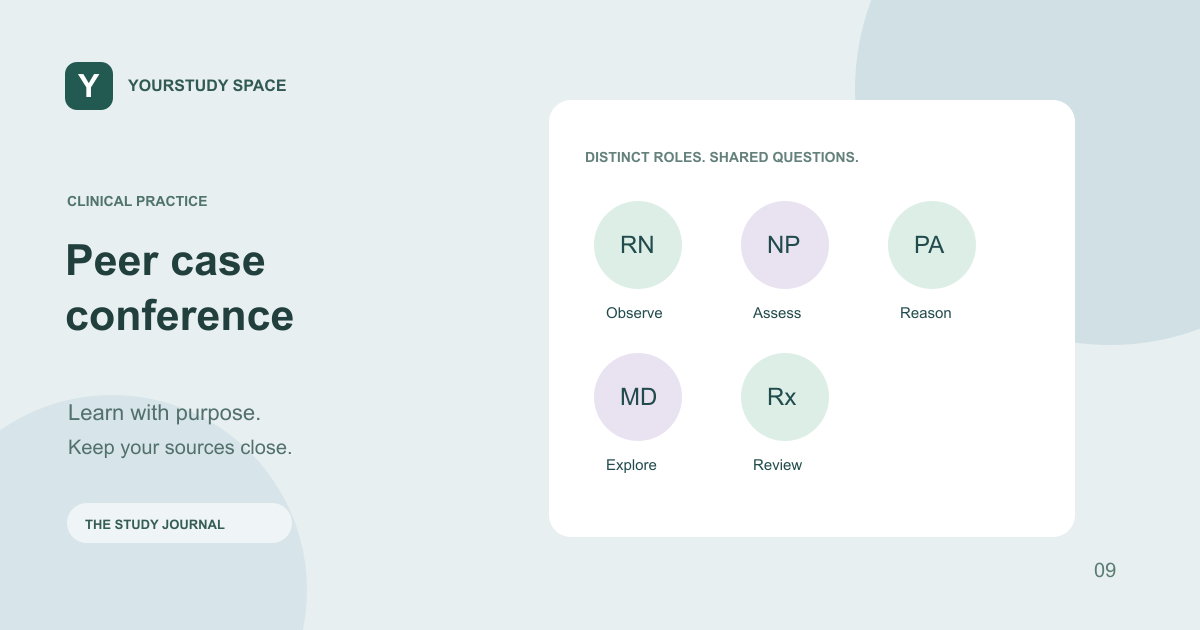
Students from different disciplines can contribute distinct perspectives. A pharmacy student might focus on medication-related problems; a nursing student might emphasize observations, monitoring and escalation. NP, PA and medical students can explore assessment and management within their training. These perspectives overlap without being interchangeable.
Use references to resolve the right dispute
When someone adds a reference, ask which claim it supports. A paper’s title alone does not settle the question. Check the passage, population and date together. If the source is course material, identify it as such; if it is public guidance, name the jurisdiction.
Tunza AI can support explanation and discussion, but its output is not a deciding vote. A disagreement that cannot be resolved from the available sources is a useful question to take to an instructor. Do not manufacture certainty to finish the conversation.
Close with a shared takeaway
End by writing a concise statement of what the group agrees on, what remains uncertain and what each participant will review. Keep the case in its fictional learning context. An organized closing note is more useful for the next session than a long discussion with no recorded conclusion.
TRY THIS NEXT
Ask every participant for one observation, one interpretation and one source-supported question.
Try it in the app ↗Sign-in and an active trial or membership are required for study tools.About this guide
This product guide was prepared with AI assistance and checked against the app’s implemented workflows. It is not independently clinically reviewed. Features and service availability can change. It contains no real patient information.
For study support only. Review generated content and its sources; do not use it for real-patient diagnosis or treatment. Read the study and AI disclaimer.
Found something that needs correcting? Contact the YourStudy Space team.