Clinical practice / Debrief & Study review
Turn a simulation debrief into your next study session
Use recorded actions, missed cues and uncertainty to make a focused plan after a fictional clinical encounter.
Separate the outcome from your reasoning
A fictional patient improving does not mean every decision was justified. A deteriorating patient does not mean every action was wrong. Start the debrief by reconstructing what you knew when you acted. Compare your reasoning with the case information that was available at that moment.
Look at the recorded actions rather than relying only on memory. Did you review an allergy before a medication decision? Did you interpret the returned result? Did you reassess after an intervention? A useful reflection names an observable action or omission.
Choose one learning gap
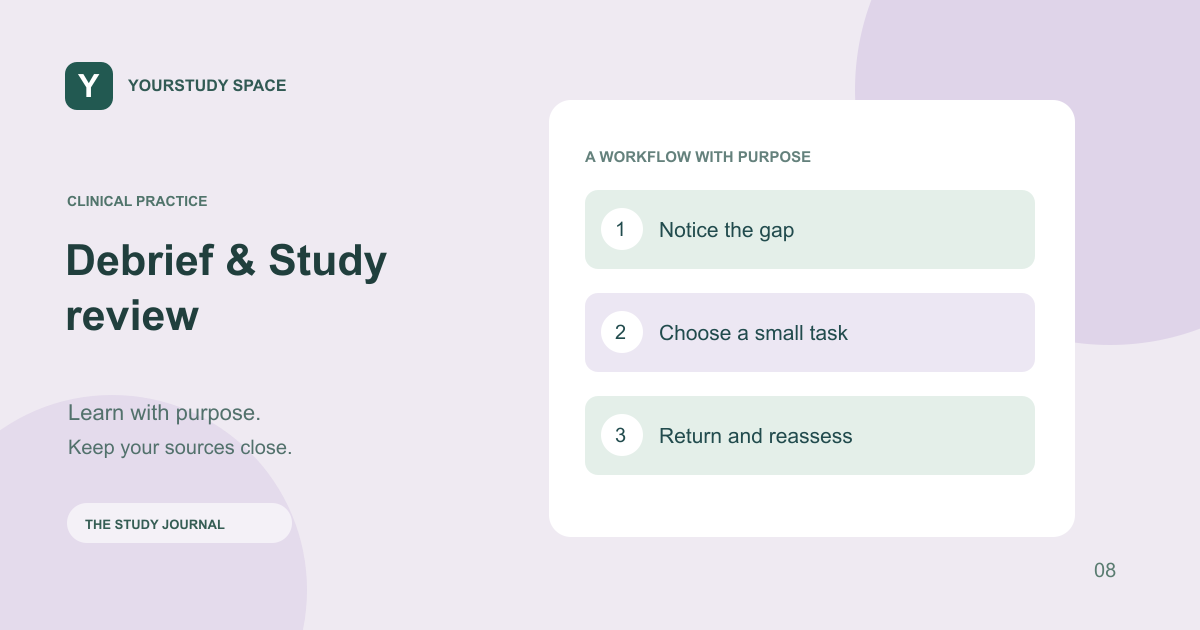
Sort the difficult moment into a practical category: missing knowledge, missed observation, interpretation, prioritization, communication or documentation. These are prompts for your own reflection, not a validated assessment score. The category helps you choose a next activity.
If you did not know the concept, use Explain or a focused source search. If you knew it but failed to notice it, repeat a case and deliberately check that cue. If your documentation was unclear, compare your note with the encounter rather than generating more unrelated questions.
Build a small follow-up task
Use Study Kit for a short set on the exact distinction you missed. A comparison table can make two similar ideas easier to inspect; a few practice questions can expose whether you can apply the distinction. Check the source support before saving a generated rationale as something to learn.
Study review uses activity and recorded responses to highlight material to revisit. Its suggestions are study signals, not a diagnosis of your ability. You can still choose a topic that matters for tomorrow’s class or rotation even when it is not at the top of the list.
Repeat with a question in mind
Before another attempt, write a prediction: “This time I will reassess after the intervention and explain what changed.” Afterward, check whether you actually did it. Keep the comparison specific. Avoid turning a simulation score into a claim that you are ready for unsupervised patient care.
TRY THIS NEXT
Leave the debrief with one observable behavior to practice and one source to review.
Try it in the app ↗Sign-in and an active trial or membership are required for study tools.About this guide
This product guide was prepared with AI assistance and checked against the app’s implemented workflows. It is not independently clinically reviewed. Features and service availability can change. It contains no real patient information.
For study support only. Review generated content and its sources; do not use it for real-patient diagnosis or treatment. Read the study and AI disclaimer.
Found something that needs correcting? Contact the YourStudy Space team.