Evidence & understanding / Public sources
What public evidence and RAG mean in YourStudy Space
Learn how retrieved passages, open-access papers, guideline pages and drug references contribute to a source-grounded study answer.
Retrieval comes before the answer
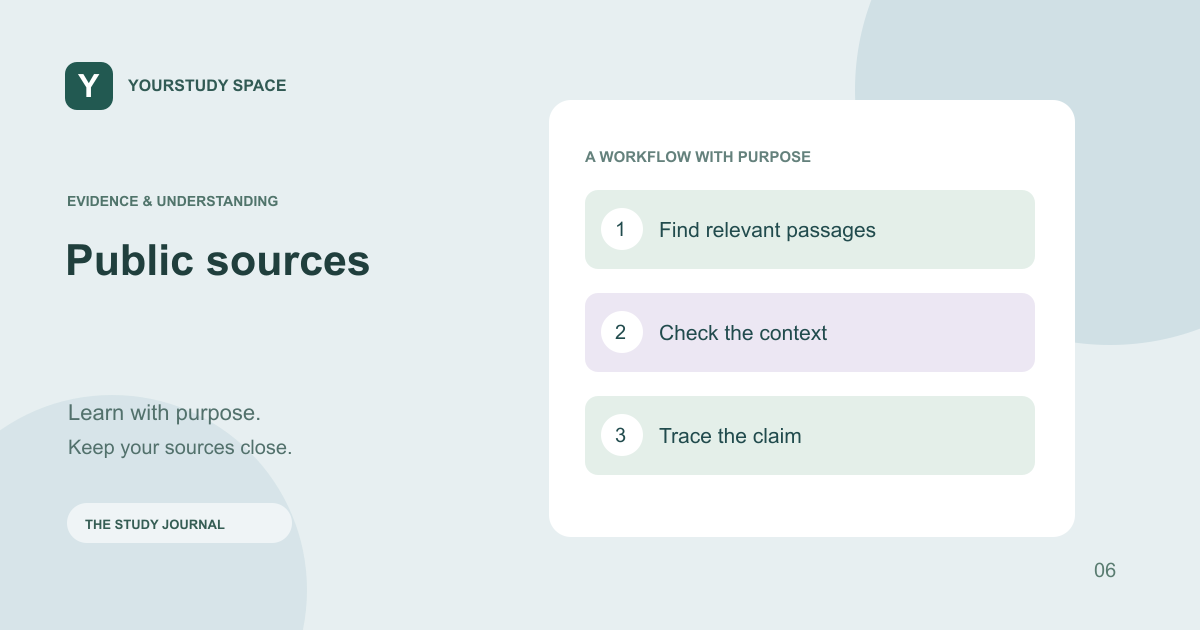
Retrieval-augmented generation, or RAG, means selecting relevant source passages and providing them to the model along with the question. In YourStudy Space, the sources can include indexed public material and readable passages from the signed-in user’s Library, depending on the chosen tool and source settings.
This is different from asking a model to answer only from its general training. It gives the response specific material to cite. It does not prove that retrieval found the best source, that an excerpt contains every qualification or that the model interpreted it correctly.
Different references answer different questions
PubMed supplies indexed literature and available abstracts. PubMed Central retrieval is restricted to the open-access subset when article-body passages are used. Europe PMC, OpenAlex and Semantic Scholar provide additional available research material. A selected directory supplies accessible official health and guideline pages.
DailyMed and openFDA can supply prescribing-information passages. RxNorm helps identify drug names and formulations. ClinicalTrials.gov describes registered studies; a trial record is not itself a practice guideline. UpToDate is not a connected source, and the app cannot bypass a publisher’s paywall.
Read the jurisdiction and the population
Public Sources lets you explore material and retrieve additional results. A country selection can influence reference choices, but guidance from different countries is not automatically interchangeable. Check the population, publication or update date, and the setting for which a recommendation was written.
Open access describes availability, not quality. A recent laboratory paper may be irrelevant to a bedside question, while an official treatment page may directly address it. Use the app’s source labels and the actual text rather than treating the number of citations as a quality score.
Keep the limitations visible
APIs may be unavailable or rate-limited, and some pages cannot open in an embedded reader. Use the available external-opening option when a source requires its own browser session. If only a partial passage was retrieved, return to the complete source before treating a summary as complete coverage.
TRY THIS NEXT
Check relevance, source type, population, country and date—not just whether a citation exists.
Try it in the app ↗Sign-in and an active trial or membership are required for study tools.About this guide
This product guide was prepared with AI assistance and checked against the app’s implemented workflows. It is not independently clinically reviewed. Features and service availability can change. It contains no real patient information.
For study support only. Review generated content and its sources; do not use it for real-patient diagnosis or treatment. Read the study and AI disclaimer.
Found something that needs correcting? Contact the YourStudy Space team.